.webp)
/
Self-Employed
Self-Employed
Self-Employed Mortgages: The Complete UK Guide
5 min read
Updated
September 2026
Written by the Bad Credit Queen team. Reviewed by Christian Queen, FCA-regulated mortgage broker.
This blog covers:
Yes, you can get a mortgage if you are self-employed. The process is the same as anyone else. The only difference is how you prove your income.
A self-employed mortgage sounds like it should be complicated. It is not. The mortgage itself works exactly the same way as any other application. The only thing that changes is how you prove what you earn, and that part trips people up more than it needs to.
This guide covers how lenders assess self-employed income, what documents you need, how much trading history and deposit you need, the most common reasons applications get declined, and what happens if you also have bad credit.
Can You Get A Mortgage If You Are Self-Employed?
Yes. Self-employed people get mortgages every day in the UK.
Being self-employed does not make you a higher risk to a lender. It simply means your income looks different on paper, and that requires different paperwork to prove it.
Many high-street banks rely on automated underwriting systems built around predictable, employed salaries. Irregular or variable self-employed income can confuse these systems, leading to unnecessary declines even when the underlying income is perfectly strong. Specialist lenders, and mainstream lenders with more experience of self-employed applicants, assess this kind of income manually and understand how to read it properly.
The real key to a successful self-employed mortgage application is understanding exactly what a lender needs from you before you apply, not after.
How Do Lenders Assess Self-Employed Income?
It depends on how your business is structured. Sole traders, limited company directors, and contractors are all assessed differently.
What Documents Do You Need for a Self-Employed Mortgage?
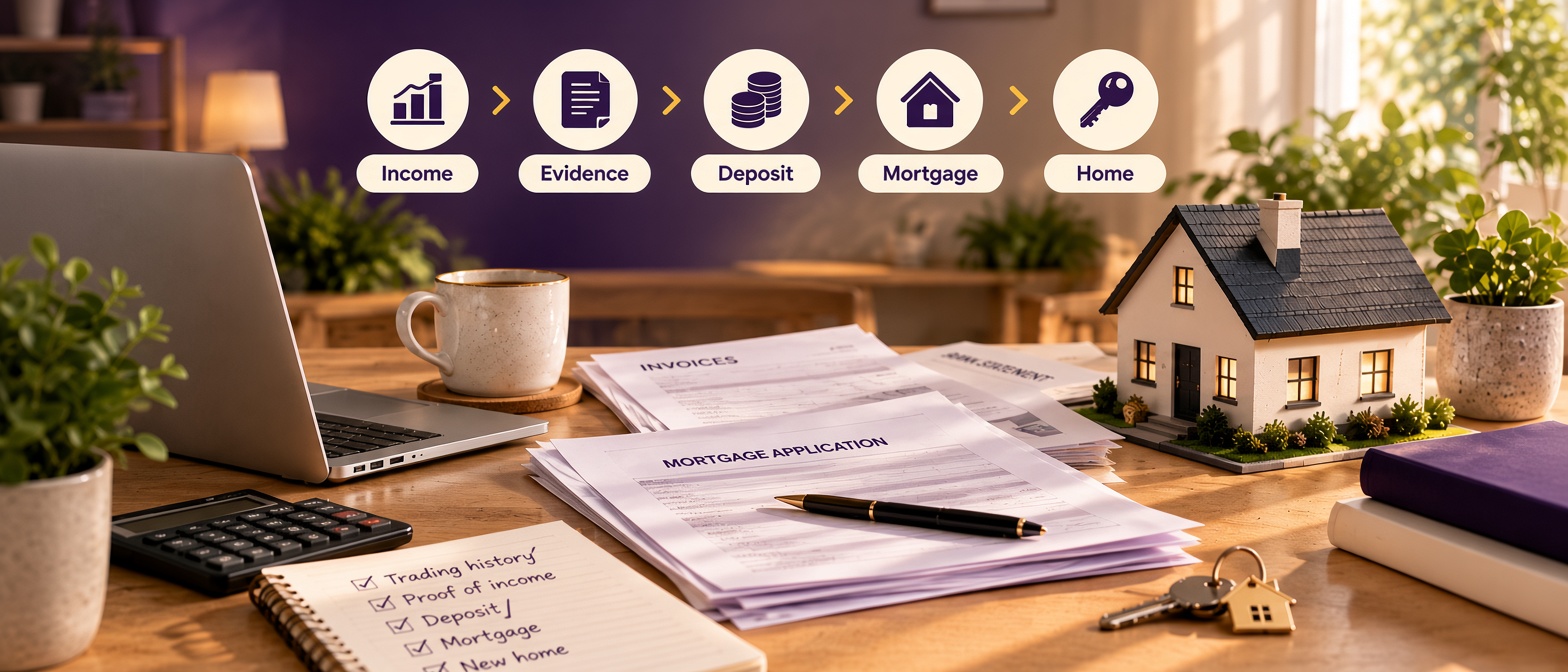
The documents you need depend on your business structure, but there is a core set that almost every lender will ask for.
- Your SA302 tax calculation from HMRC, usually covering the last two to three years.
- A tax year overview from HMRC, which confirms the figures on your SA302 are correct.
- Business accounts, at least one to two years' worth, prepared by an accountant.
- An accountant's certificate or reference letter, which some lenders accept alongside or instead of full accounts.
- Personal bank statements, and sometimes business statements too, usually covering the last three months.
- Proof of upcoming contracts, if you work as a contractor.
Having these documents ready before you apply speeds up the process considerably. Missing paperwork is one of the most common causes of delay, and delays can cost you a property.
How Much Trading History Do You Need?
Most lenders want at least two years of trading history. Some accept one year. Very few accept less.
Gaps in your trading history, or recent changes to your business structure, can complicate an application. A broker can advise on how to present these to a lender in the best light.
Not sure where your own situation stands? Our Criteria Hub breaks down exactly how trading history, income structure, and deposit affect your options. Check the Criteria Hub →
How Much Deposit Do You Need as a Self-Employed Borrower?
The same as anyone else, in most cases. Self-employment alone does not require a larger deposit.
With clean credit and two or more years of trading history, a deposit of five to ten percent is often enough to get you competitive rates from a good range of lenders.
If your trading history is shorter, around one year, or your income fluctuates from year to year, a larger deposit of fifteen to twenty percent will strengthen your application and open up more lender options.
If you also have bad credit on top of being self-employed, deposit expectations increase further. We cover that combination later in this guide.
Why Do Self-Employed Mortgage Applications Get Declined?
Most self-employed mortgage declines are avoidable. They happen because of preparation gaps, not because being self-employed is a problem.
- Applying to the wrong lender. An automated system built around employed applicants can reject strong self-employed income simply because it does not fit the standard pattern. A specialist or experienced lender reads the same income very differently.
- Insufficient trading history. Applying before you have a full year of accounts behind you.
- Mixing personal and business finances, which makes it harder for a lender to see a clean picture of what you actually earn.
- Fluctuating income without explanation. Lenders want to see consistency, or at least understand the reason behind the variation.
- Not having documents ready, such as your SA302, accounts, or recent bank statements.
- Making multiple applications after a decline. Each hard credit search damages your file further and can trigger a spiral of rejections.
None of these are permanent problems. With the right preparation and the right lender, most of them are avoidable entirely.
What If You Are Self-Employed AND Have Bad Credit?
This narrows your options further, but it does not eliminate them.
Combining self-employed income with adverse credit means most high-street lenders will decline automatically, often without a human ever looking at your file. Specialist lenders work differently. They assess both factors on their own merits rather than as an automatic red flag.
The key factors specialist lenders look at are the type of credit issue you have, how recent it is, the size of your deposit, and how well your self-employed income is structured and documented.
If you are self-employed with bad credit, our dedicated self-employed bad credit mortgage page covers the specific lender requirements and how we help.
For broader guidance on all types of adverse credit, read our adverse credit mortgage advice.
Should You Use a Mortgage Broker If You Are Self-Employed?
For most self-employed applicants, using a broker gives you a better chance of approval and often a better deal.
Brokers who specialise in self-employed income know how to present complex earnings to a lender in the most favourable way. They also have access to lenders that never appear on comparison websites, and they soft-search the market first, so your credit file is not damaged before you have even found the right lender.
There is a real difference between a tied broker, who works from a limited panel of lenders, and a whole-of-market broker, who searches everything available to find the best fit for your circumstances.
Applying directly to several lenders yourself carries real risk. Each hard search leaves a mark on your credit file, and a run of rejections can make the next application harder still.
As an FCA-regulated bad credit mortgage broker , we specialise in self-employed and complex income cases across the whole market.
How Do You Prepare for a Self-Employed Mortgage Application?
Good preparation is the single biggest factor in whether a self-employed mortgage application succeeds.
- Get your SA302 and tax year overview from HMRC. Aim to have two to three years ready.
- Ask your accountant to prepare up-to-date accounts, or an accountant's certificate if your latest year is not yet filed.
- Separate your personal and business finances cleanly. Lenders check both, and a clean split makes your income far easier to assess.
- Check your credit file with all three agencies, Experian, Equifax and TransUnion, or use a service like Check My File. Fix any errors before you apply.
- Save the largest deposit you reasonably can. A bigger deposit widens the range of lenders willing to consider you.
- Hold off on new credit applications for the three to six months leading up to your mortgage application.
- Speak to a broker before approaching any lender directly, so your application is presented properly the first time.
Want to know where you stand? Share your details and we will give you a clear assessment. No cost, no obligation, and no impact on your credit file.
Related Reading
.avif)
.avif)
.avif)
.avif)