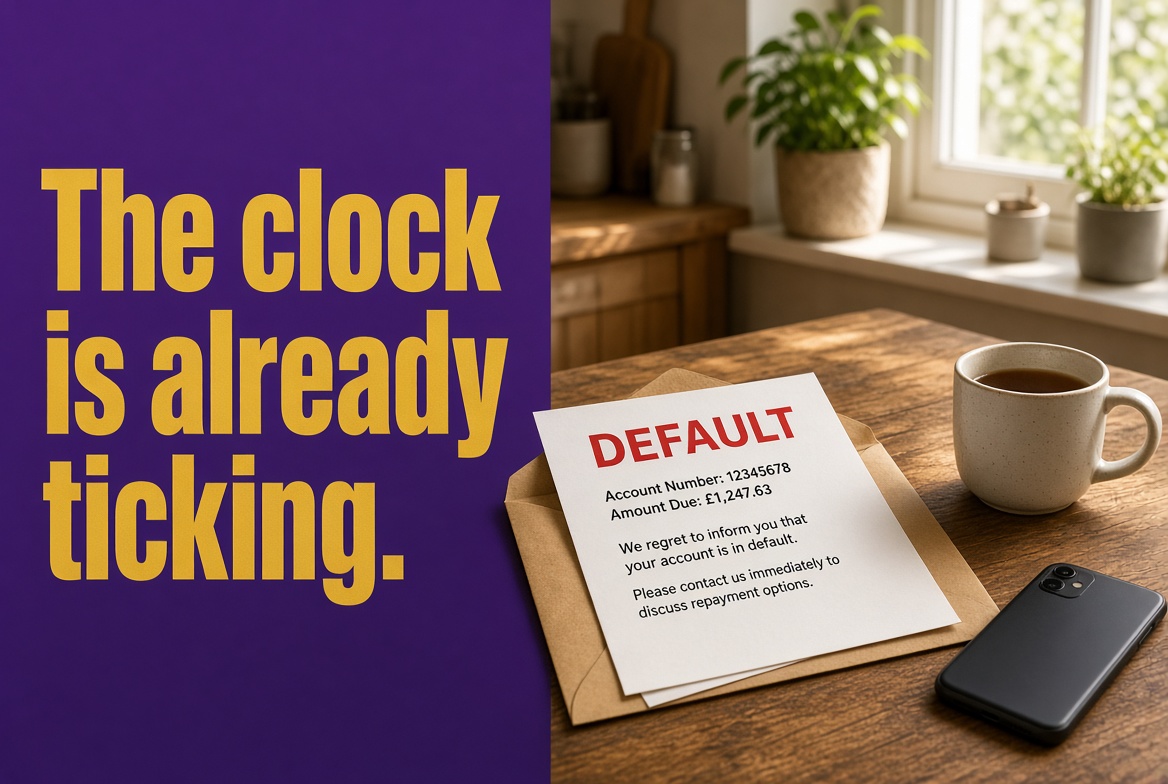
Six years. A default stays on your credit file for six years from the date it was registered.
Same headline number as a CCJ, but the mechanics underneath work a little differently. Knowing those differences can save you time and a fair bit of stress.
This blog covers what a default actually is, whether it can be removed early, how it differs from a CCJ and what you can do about a default sitting on your credit file right now.
What Is a Default and How Does It End Up on Your Credit File?
A default is a record added to your credit file when you have fallen significantly behind on a credit agreement. It is the lender's formal way of saying the relationship has broken down.
It usually happens after three to six consecutive missed payments on a loan, credit card, phone contract, or other credit agreement. The exact trigger point varies by lender, but the pattern is the same.
Before the lender can register a default, they must send you a formal default notice. This gives you 14 days to bring the account up to date. This is a legal requirement, not optional.
The default is registered on the date the lender reports it to the credit reference agencies, which is not always the same as the date you received the notice. The six-year clock starts from the registration date.
Defaults can come from any credit agreement, not just loans. Phone contracts, energy bills on credit and buy-now-pay-later arrangements can all result in defaults.
What Is the 6-Year Rule for Defaults?
A default stays on your credit file for six years from the date it was registered, much like a CCJ.
The six-year period runs from the registration date, not from when you first missed a payment. These can be months apart, so the clock may already have been ticking before the default appears.
The default stays for the full six years whether you pay it off or not. Paying changes the status to satisfied but does not remove the record early.
After six years, the default is automatically removed. No action is needed from you.
This is where defaults differ meaningfully from CCJs. There is no option to remove a default early by paying quickly within a set window. There is no set-aside process. Once registered, a default stays for the full six years. No exceptions.
Not sure where your own default stands? Our Criteria Hub breaks down exactly how age, amount, and satisfaction status affect your options. Check the Criteria Hub →
Satisfied vs Unsatisfied Default: What Is the Difference?
A satisfied default means you have paid the debt in full and is looked upon much more leniently. An unsatisfied default means you still owe the money.
Both stay on your file for six years, but lenders view them very differently. A satisfied default tells lenders you took responsibility and cleared the debt. It opens more mortgage lender options and often better terms.
An unsatisfied default is viewed as higher risk. Lender spread will remain low, and a higher deposit is usually needed to offset the risk.
Partial payments do not satisfy a default. Only paying the full outstanding amount changes the status on your file. Some lenders will accept proof of an active payment arrangement, but most want to see full satisfaction.
If you can afford to pay off an outstanding default before applying for a mortgage, it is usually worth doing so.
Six years isn'tthe whole story.
Paying a default off does not wipe it. It stays 6 years. Two things you can actually do.
DEFAULT
Date registered 14 May 2024
Amount £1,347.25
Status: Unsatisfied
LENDER RECORD
Pay and Mark Satisfied
Pay the full balance. Status changes to Satisfied. Still on file for 6 years, but lenders treat it better.
DEFAULT Registered→Satisfied on file
A default is the lender's record, not a court order.
No early wipe
Normally 6 Years
Dispute If Incorrect
If the default is wrong or was never yours, raise it with the credit agency. That is the only common early-removal route.
DEFAULT Registered→Corrected or removed
0–12 monthsStrongest impact
12–24 monthsImpact eases
2–3 yearsMore lenders open
3–6 yearsOptions widen
After 6 yearsAutomatically drops off
How Is a Default Different From a CCJ?
A default and a CCJ are related but different. A default is generally less severe. A CCJ is a court order and carries more weight.
A default is the lender's own record of your failure to repay. A CCJ is a County Court Judgment, a legal ruling made by a court. A CCJ appears on the public Register of Judgments, Orders and Fines, which a default does not.
A default can exist without a CCJ. But if the debt goes unresolved and the lender takes you to court, a CCJ may follow. Many CCJs start life as an unpaid default.
For mortgage purposes, a CCJ is treated more seriously than a default. A small, satisfied default from three years ago is much easier to work with than a recent CCJ.
Both stay on your credit file for six years from their respective registration dates.
The impact of a default on your credit file and your financial options does not stay constant. It shifts significantly over time.
0 to 12 months after registration: Impact is at its strongest. Your credit score sits at its lowest point from the default. Mortgage options are most limited and the largest deposits are required.
12 to 24 months: The impact begins to ease. If the default is satisfied and your recent credit behaviour is clean, some specialist lenders will start considering you.
2 to 3 years: A genuine turning point. Many specialist lenders relax their criteria at the two-year mark. Deposit requirements reduce and interest rates improve.
3 to 6 years: The default carries progressively less weight with each passing month. By year four or five, many lenders treat an older, satisfied default as a minor factor rather than a deciding one.
After 6 years: The default drops off your credit file entirely. It no longer appears on any lender search, with no trace left behind for anyone checking your file later.
The impact fades gradually, not all at once. Each month that passes helps a little. The milestones above are simply where the shift becomes most noticeable.
0-12 MONTHS
Impact is strongest, score lowest, deposits most limited.
1-2 YEARS
Impact eases. Specialist lenders consider you if criteria met.
2-3 YEARS
Turning point, criteria relax, lower deposits, better rates.
3-6 YEARS
Weight lessens monthly, becoming a minor factor by year five.
AFTER 6 YEARS
Drops off completely with no trace left on your credit file.
Can You Get a Mortgage With a Default on Your File?
Yes. A default does not stop you from getting a mortgage.
Specialist lenders consider applications with defaults regularly. The age of the default, the amount, whether it has been satisfied and your deposit all affect which lenders will say yes. Defaults are one of the most common and most manageable adverse credit markers and the outlook is often better than people expect.
For the full breakdown of how defaults affect mortgage applications, including deposit expectations, lender criteria and how to apply without damaging your credit file, visit our dedicated mortgage with default.
Does a Default Affect Your Credit Score?
Yes. A default causes a noticeable drop in your credit score when it is first registered.
The drop is sharpest at the point of registration. Over time, the score gradually recovers as the default ages, even while the record itself is still on your file.
Your score recovers faster if you are managing your other credit well: paying on time, keeping balances low and not applying for unnecessary new credit.
Different credit reference agencies may show different score impacts. The score you see on one service may not match the score on another, which is why checking more than one gives you a fuller picture.
How Do You Check If a Default Is on Your Credit File?
You can check for free with the three main UK credit reference agencies:
Experian, Equifax and TransUnion each offer a free statutory credit report.
ClearScore uses Equifax data and Credit Karma uses TransUnion data, both free for ongoing access.
Check My File pulls all three agencies into a single view, which is often the quickest way to see everything at once. It's a paid subscription with a free trial, worth cancelling before the trial ends if you don't want to continue.
Look for three things: the registration date, because this is when the six-year clock started, the amount and whether the default shows as satisfied or unsatisfied.
If anything is incorrect, dispute it with the agency directly. Errors happen and a wrongly recorded default can be corrected or removed if you can prove it is inaccurate.
What Should You Do About a Default on Your Credit File?
If you have a default on your file and you are thinking about a mortgage, here is what to do.
Check your credit file with all three agencies, or use Check My File. Verify the default details: the date, the amount and the status. Dispute anything incorrect with the credit reference agency directly.
If you can afford to pay off the default, do so. Make sure the status updates to satisfied on your file. This widens your lender options significantly and often improves the rates available to you.
Do not apply directly to multiple lenders. Each application leaves a hard search on your file and multiple searches make future applications harder. Speak to a specialist broker who soft-searches first.
As an FCA-regulated bad credit mortgage broker, we specialise in helping people with defaults find the right specialist lender without damaging their credit file further.
.webp)


.avif)
.avif)
.avif)
.avif)